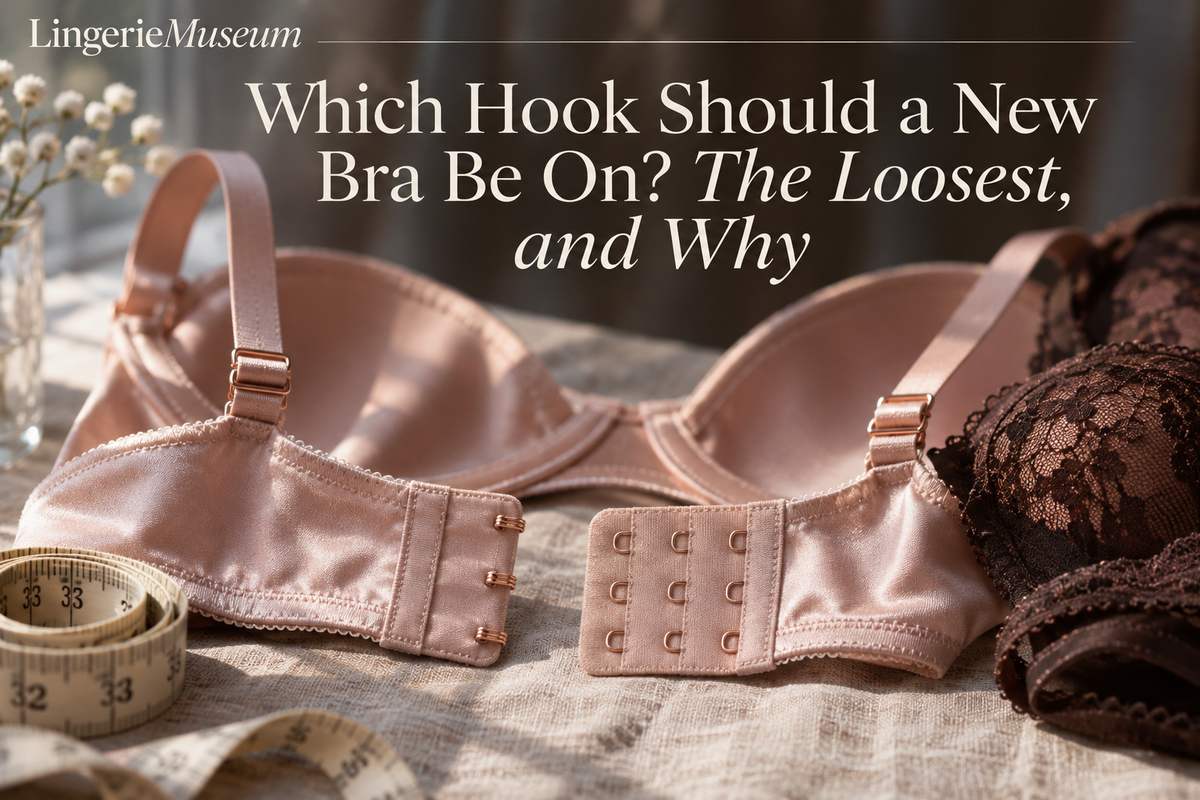
A new bra should be fastened on the loosest hook, the outermost column of eyes, and it should already feel firm there. The band's elastic relaxes with every wear and wash, and the two tighter columns are the reserve you move into as it does. If a brand-new bra only feels secure on the tightest setting, the band is too big.
What fitters and bra makers say about the loosest hook
The advice is close to unanimous. Triumph's fitting pages put it in one line: "If your bra is new, it should fit on the loosest hook." Honeylove gives the same instruction and the reason for it: starting loose "gives you room to maintain proper support as your bra ages." Wikipedia's bra-size entry sums up the trade view as choosing "a bra band that fits well on the outermost hooks," so that the tighter hooks can take up the slack later.
There is one mild dissent. Wacoal's US fit pages suggest the middle hook, so you can go looser or tighter as weight and hormones shift. That makes sense for a body that changes size often. For most people the loosest column is the better starting point, because the band only ever gets looser, never tighter.
Starting on the tightest hook spends the reserve on day one. The bra fits for a few weeks, the elastic relaxes, and there is nowhere left to go.
Why a bra band stretches
The band is the part that holds you up. Honeylove puts its share of the support at 80 to 90 percent; Wacoal's figure is 70 percent. That band is almost always knitted with spandex (elastane in Europe), the fiber the chemist Joseph Shivers developed at DuPont in 1958. It can stretch to about five times its length and recover, but the recovery is never quite complete.
Triumph says it plainly: "As you wear and wash your bra, the elasticity will change." Heat speeds the process up. Honeylove warns that the glues and elastics in most bras "can degrade over time when exposed to excessive heat," which is the main argument against the tumble dryer. Wikipedia gives a working lifetime for a bra band of about eight months of regular wear.
When to move to the next hook
Move in one column only when the band tells you to. The usual signs:
- The band rides up at the back during the day, so the back sits higher than the front.
- You can pull it well away from your spine, rather than the snug two-finger gap most fitters look for.
- The straps start to dig, because they are taking weight the band has stopped carrying.
There is no fixed calendar for this. A bra in daily rotation will need the middle column sooner than one worn twice a week. When even the tightest column closes without much tension, Triumph's verdict is that "it's time for a new bra."
A new bra that only fits on the tightest hook
If a bra fresh from the fitting room needs the tightest setting to feel secure, the band is a size too large. Honeylove's advice is to go down a band size and adjust the cup: a 36C becomes a 34D, the sister size with the same cup volume on a shorter band.
The opposite problem has two causes. A band that pinches on the loosest hook may simply be too small, but Wikipedia notes that a band can also feel tight "due to the cups being too small," because a cup that cannot hold the breast pushes the band outward. Check the cups for spillage before you go up a band.
How many hooks a bra has, and why
Bra closures are sold as hook-and-eye sets described as hooks high by columns wide. Bra-makers Supply, which sells to home sewers, lists sets of 2x3, 3x3, 4x3 and 5x3. The three columns are the adjustment; the number of hooks high follows the depth of the band. They are three settings on one size, not three sizes.
Bigger cups need a deeper band, so the hook count rises with cup size. Fantasie's Illusion side-support bra, for example, has a 2-hook fastening on D to FF cups and a 3-hook fastening on G to J cups. A longline bra runs a column of hooks up a band that can reach the waist. Small-cup bras often get by with one or two hooks high.
A front-closure bra is the exception. The fastening sits at the center gore, and Bra-makers Supply explains that designers almost always use a single column there, because a wider tape would sit over the breast. That means no adjustment at all: a front-closure band has to fit exactly from the start, and it cannot be tightened later. Our bra type guide sets it beside the other main styles.
Where the back hook came from
Mary Phelps Jacob patented her backless brassiere in 1914. According to Wikipedia's history of the garment, adjustable bands using multiple hook-and-eye closures arrived in the 1930s, the same decade the underwire was developed and Warner began putting cup sizes on its bras, in 1937. Nearly a century later, those columns of eyes are still the only part of most bras you can adjust to fit the band.
Last updated
Questions
Should a new bra feel tight on the loosest hook?
It should feel firm, not tight. On the loosest hook the band should sit level around your ribcage and stay put when you lift your arms, with room to slide about two fingers underneath. If it pinches or leaves deep marks there, check the cups first, then try one band size up.
How do I know when to move my bra to the next hook?
Move in one column when the band starts riding up at the back, when you can pull it well away from your spine, or when the straps begin to dig because they are carrying weight the band no longer holds. There is no fixed schedule: a bra worn daily needs it sooner.
Why do bras have three columns of hooks?
The three columns are three tension settings on one band size, not three sizes. You start on the outermost, loosest column and move inward as the spandex in the band relaxes with wear and washing, which keeps the band firm for longer before the bra needs replacing.
Is it bad to wear a new bra on the tightest hook?
It wastes the bra's adjustment. If a new bra only feels secure on the tightest hook, the band is too large, and once the elastic relaxes there is no tighter setting left. Try one band size down with one cup size up, the sister size, for example 34D instead of 36C.
Sources
- sg.triumph.com: how to put on a bra
- honeylove.com: should i wear the tightest or loosest bra hook
- honeylove.com: why do bras have hooks
- honeylove.com: can bras go in the dryer 1
- en.wikipedia.org: Bra size
- en.wikipedia.org: Brassiere
- en.wikipedia.org: Spandex
- en.wikipedia.org: Mary Phelps Jacob
- braandcorsetsupplies.com: hooks and eyes unhook the mystery
- johnlewis.com: p114085730
- wacoal-america.com: bra anatomy
- au.triumph.com: bra accessories
Discussion
Loading...