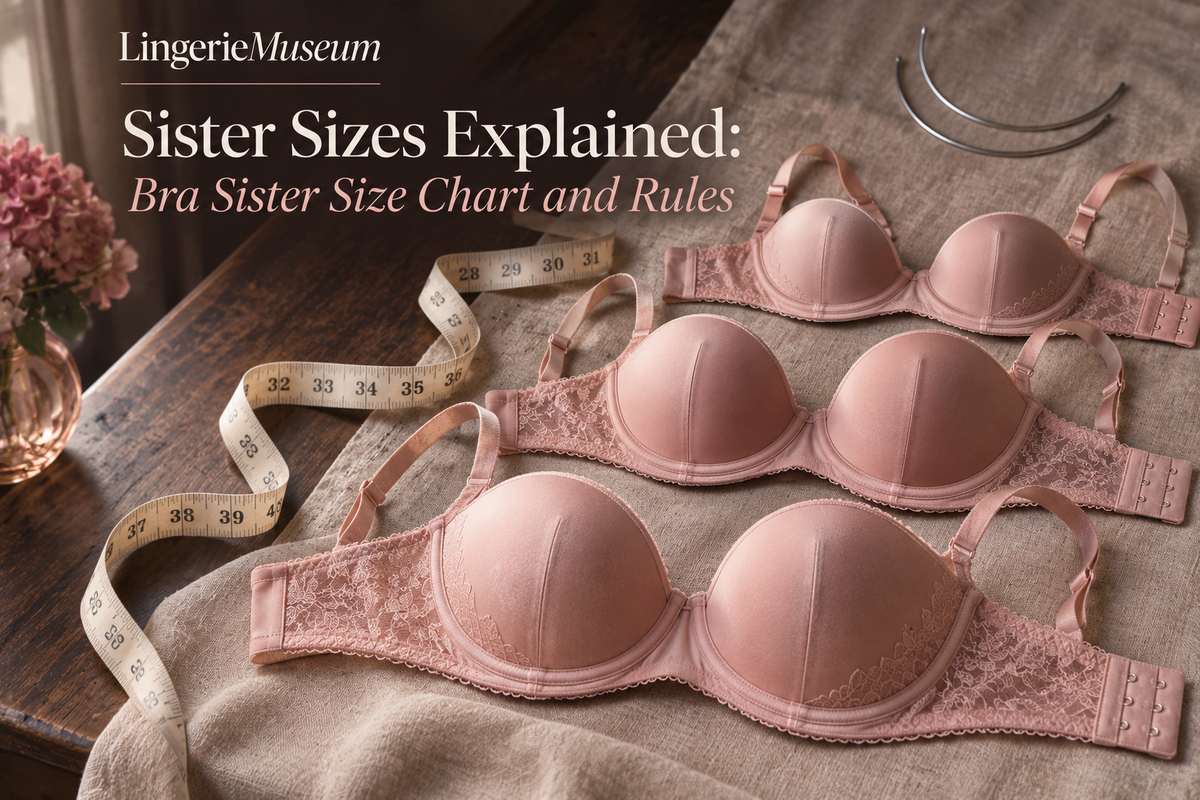
Bra sister sizes are sizes that hold the same cup volume on a different band: go up one band size and down one cup letter, or down one band and up one cup. A 34C, a 32D and a 36B are sister sizes. Reach for one when the cups of your usual size fit but the band is a little tight or loose, or when your size is sold out.
Why a C cup is not one fixed size
A cup letter is a difference, not a volume. Wikipedia's entry on bra measurement puts it plainly: the cup size "is calculated by subtracting the band size from the over-the-bust measurement." In US and UK sizing each letter is roughly one inch of that difference; continental European cups go up one letter for every 2 cm.
So a C on any band means about three inches between ribcage and bust. But the cup on a 38 band has to wrap a much wider chest than the cup on a 32, so it is wider and holds more. A 38C is a far larger cup than a 32C.
Bra makers handle this through the underwire. Wires are made in numbered sizes, and the same wire serves a whole diagonal of sizes. Wikipedia's cup-volume table, built on the pattern maker Don McCunn's underwire charts, lists the sister sizes that share each wire size, and Bratabase, the bra-measurement community site, notes that sister sizes share the same underwire piece. Swap a 34C for a 36B and the wire's curve stays put while the band gets longer.
How to work out a sister size
Count one band step against one cup step, in opposite directions:
- Sister size up: band up one size (34 to 36), cup down one letter (C to B).
- Sister size down: band down one size (34 to 32), cup up one letter (C to D).
US and UK bands move in steps of 2 inches. European bands move in steps of 5 cm, which is why the lingerie brand Miss Mary gives 85C, 80D and 75E as the same cup.
The catch is the alphabet. UK brands use AA, A, B, C, D, DD, E, F, FF, G, GG, H, HH, J. Some US brands go D, DD, DDD, then G, and the retailer Brastop's size converter maps a UK 28E to a US 28DDD and a UK 28F to a US 28G. Count letters in the system printed on the label. A 34DD sister-sized down is a 32E in a British bra and a 32DDD in an American one; both are one cup step up.
The most common mistake is changing only the band. Brastop's own example: moving from a 34FF to a 36FF to ease a tight band also makes the cup one size bigger, because the same letter on a larger band is a larger cup. If the band is the only problem, the letter has to come down.
Bra sister size chart
Each row below is one sister-size family in UK cup letters. Read across: every size in a row has the same cup volume. For a US brand that uses DDD, replace E with DDD and F with G, then count from there.
| 30 | 32 | 34 | 36 | 38 | 40 |
|---|---|---|---|---|---|
| 30D | 32C | 34B | 36A | 38AA | - |
| 30DD | 32D | 34C | 36B | 38A | 40AA |
| 30E | 32DD | 34D | 36C | 38B | 40A |
| 30F | 32E | 34DD | 36D | 38C | 40B |
| 30FF | 32F | 34E | 36DD | 38D | 40C |
| 30G | 32FF | 34F | 36E | 38DD | 40D |
| 30GG | 32G | 34FF | 36F | 38E | 40DD |
| 30H | 32GG | 34G | 36FF | 38F | 40E |
| 30HH | 32H | 34GG | 36G | 38FF | 40F |
The first row matches Wikipedia's example of one cup volume (30D, 32C, 34B, 36A); the seventh matches Bravissimo's family for a 40DD.
When a sister size is the right fix
Bravissimo suggests sister sizes when "your bra band feels a little too tight or too loose" and the cups are fine, or when your usual style is out of stock.
The band digs in, the cups fit. Go up a sister size: a 34C becomes a 36B. The cup keeps its shape and the band gains two inches.
The band rides up your back, the cups fit. Go down a sister size: a 34C becomes a 32D. A band that climbs is too loose to anchor the bra, and Bravissimo points out that "the back band does most of the support."
Your size is gone. Bratabase's example is a 34D wearer facing an empty shelf: try the 36C, not the 36D, which would be too big in the cups.
Where sister sizing breaks down
It is an approximation, and the approximation wears thin quickly.
More than two steps. Bratabase advises against sister sizing more than two steps in either direction, because the rest of the bra stops matching the body. A 30GG and a 40DD share a cup volume on paper and almost nothing else.
Cup depth and shape. Bratabase notes that sizing up tends to give a slightly shallower cup and sizing down a slightly deeper one, and that some brands keep the cup pattern the same across a family while others reshape it. The result can be gaping at the top or a cup cutting in. Styles differ too: a plunge bra and a balconette of the same size cover the breast in very different places, so a sister size that works in one may not in the other.
Across brands. Grading varies, so Bratabase calls sister sizing most reliable within one model. Our complete bra type guide shows how far construction varies between cuts.
Dodging a band that fits. Sizing up again and again to get a smaller cup, Bratabase warns, ends with a band that is too big. Miss Mary goes further for a heavy bust and advises against the larger-band sister altogether, since the band risks being too loose to support.
The cups are the problem. If you spill over the top or the cup sits half empty, no sister size helps. Miss Mary treats that as the wrong size altogether, which means a new size, not a neighbor of the old one.
The whole system leans on the underwire bra, whose wire fixes the cup's curve. A stretch bralette sold in S, M and L has no sister sizes at all: it has no cup letter to trade.
Last updated
Questions
Is a 34C the same as a 36B?
They are sister sizes, so the cups hold about the same volume and usually share the same underwire. The 36B has a band about two inches longer. If a 34C fits in the cup but the band feels tight, a 36B is the first size to try. If the band already fits, the 34C stays the right size.
Should I go up or down a sister size if my band is tight?
Go up. Move the band up one size and the cup down one letter, so a 32DD becomes a 34D in UK sizing. Keeping the same letter on a bigger band would give you a cup one size larger than before, which is the most common sister-sizing mistake.
Do sister sizes work across different brands?
Less reliably. Brands grade their patterns differently, so cup depth, wire shape and band firmness change from label to label. Bratabase, the bra-measurement community site, finds sister sizing most dependable within the same bra model. Across brands, treat a sister size as a starting point for a try-on, not a guarantee.
How many sister sizes can you go up or down?
One step is the safe move and two is the usual limit. Bratabase advises against going further, because the band length, cup depth and wire spacing drift too far from the size that fit. A 30GG and a 40DD share a cup volume on paper, but the rest of the bra is a different garment.
Sources
- en.wikipedia.org: Brassiere measurement
- bratabase.com: sister sizing
- bravissimo.com: sister sizes
- us.brastop.com: sister sizes explained
- missmary.com: sister sizes magic trick cup size
Discussion
Loading...