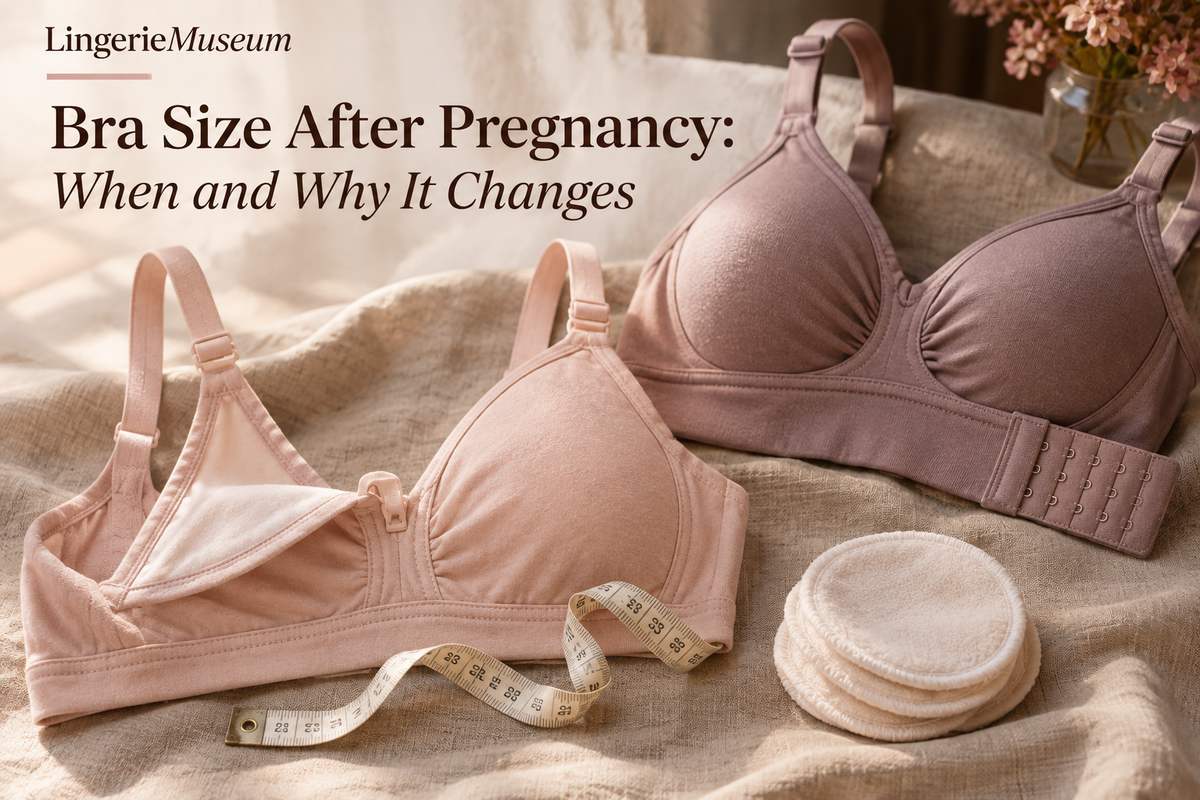
Your bra size after pregnancy is rarely the size you started with. Breasts usually grow one to two cup sizes in pregnancy, the band can widen with the ribcage, cups swing again once milk comes in, and after weaning the breasts shrink back but often not all the way. Expect to remeasure four or five times between the first trimester and a year after the last feed.
The type pages for the maternity bra and the nursing bra cover how each garment is built. This piece is about the measurements.
Four stages, four bra sizes
| Stage | What usually changes | When to measure |
|---|---|---|
| Early pregnancy | Cups fill, breasts tender | When your usual bras feel tight, often around month four |
| Second half of pregnancy | Cups and band both grow | Around 16 weeks, again in the last weeks |
| First weeks of feeding | Cups swell when milk comes in, size moves through the day | A few weeks after birth, when feeding has settled |
| After weaning | Cups shrink, shape and evenness change | Several months after the last feed |
The timings come from different advisers, and they do not all agree. The Australian Breastfeeding Association says most of the pregnancy changes "have usually happened by around 16 weeks, so this can be a good time to get fitted." The UK charity NCT says a bra bought from about 28 weeks "should still fit after the birth." The bra maker Elomi advises a fitting around the 38th week as "the most similar to your postpartum size." The common thread: buy for the body you have now.
Why the band size changes in pregnancy
The band moves too. In a 2015 review for the European Respiratory Society's journal Breathe, Antonella LoMauro and Andrea Aliverti report that the angle of the lower ribs at the breastbone widens from about 68.5 degrees early in pregnancy to about 103.5 degrees at term, and that the lower chest measures larger in the third trimester than after the birth. They explain it as the ribcage making room for a diaphragm pushed upward by the uterus.
For a bra, that means the underbust measurement can grow even while the cups still fit. A clinically reviewed patient guide published by Kaiser Permanente says that in the third trimester you "may need a larger, more supportive bra or a bra extender." An extender is a strip of extra hooks and eyes that clips onto the back closure.
This is also why maternity bras carry extra columns of hooks. The Australian Breastfeeding Association lists "adjustability in the band (extra hooks and eyes)" as a feature to look for, and adds that a firm band should carry most of the weight, not the straps. It also says: "You don't need to buy a bra thinking you'll grow into it."
The first weeks of feeding
Wikipedia's summary of the clinical literature puts the arrival of mature milk at about 50 to 73 hours after birth, when breasts "swell significantly and can feel achy, lumpy and heavy." After that, size moves with every feed. The Australian Breastfeeding Association notes that "breast size and fullness can change during the day as milk is made and removed," so a cup fitted when the breasts are empty can cut in an hour later. Measure the bust at its fullest, before a feed, and choose cups with some stretch.
On fit and health, follow the named bodies rather than shop advice. The NHS, in its page on mastitis, tells you to wear "a comfortable and supportive bra" and not to wear tight-fitting clothing or bras while the condition clears. The Australian Breastfeeding Association says "rigid underwires aren't recommended during pregnancy or breastfeeding" because a stiff wire may press on a full area of the breast, while flexible, low-gauge wires are less likely to cause problems. Ireland's health service, the HSE, recommends a bra that is not wired or padded, and adds that if you do not normally wear a bra, you do not need to start because you are breastfeeding. See underwire vs wireless bras for the construction.
Buy two or three bras at first, NCT suggests, so one can be in the wash. Wait for the size to settle before buying more.
Features that matter on a nursing bra
When you try a nursing bra on, check five things:
- A clip you can open with one hand.
- Cup room for a pad. The Kaiser guide suggests breast pads to soak up leaks, and a cup that only just closes now will be too small when full.
- A long back closure. Wikipedia notes nursing bras usually have up to four rows of hooks.
- Padded straps and a firm band. Both appear in the Kaiser and Australian Breastfeeding Association advice.
- A soft fabric. Kaiser notes that cotton bras may be more comfortable; the Australian Breastfeeding Association says seamless bras are often very comfortable in early breastfeeding.
Bra size after breastfeeding stops
Weaning starts the next change, and it is slower than the first. A 2025 study in the Journal of Breast Imaging by Noam Nissan and colleagues followed 39 women through mammograms before pregnancy, during lactation and after weaning. Breast volume rose 45 percent from before pregnancy to lactation, then fell 23.3 percent after weaning. The authors conclude that the changes reverse but "generally do not return to prepregnancy levels." The sample was small and made up of women at higher risk of breast cancer, so treat the numbers as a guide, not a forecast.
WebMD, in a medically reviewed article, says breasts "may or may not return to their pre-breastfeeding size or shape," and that some stay large while others shrink.
Uneven breasts are common too. Cora Harrington of The Lingerie Addict, writing about her own fitting in 2021, said "having two different cup sizes is not uncommon after breastfeeding," and that the larger breast sets the size. She advised waiting six or even nine months after stopping before investing in new bras, then trying several sister sizes, since the same cup volume can sit on a different band.
The old fear that nursing itself makes breasts sag has been tested. At the American Society of Plastic Surgeons' 2007 meeting, Brian Rinker's team at the University of Kentucky reported on 132 women who had sought breast lifts or augmentation. Breastfeeding made no difference to sagging. Age, smoking and the number of pregnancies did, and Rinker said the effects of pregnancy "increase with each pregnancy." A second baby, in other words, means a fresh set of measurements.
Last updated
Questions
Will my breasts go back to their pre-pregnancy size after breastfeeding?
Often not exactly. A 2025 mammography study of 39 women in the Journal of Breast Imaging found breast volume fell after weaning but generally did not return to pre-pregnancy levels. Some women end up larger, some smaller, and many find one breast now differs from the other, so a new fitting is worth it.
How long after weaning should I wait to get a new bra fitting?
Give it several months. Breasts keep changing for months after the last feed as milk-making tissue shrinks back. Cora Harrington of The Lingerie Addict suggested waiting six or even nine months before buying expensive bras. In the meantime a soft stretch bra or bralette copes with the changing size.
Does your band size go up during pregnancy?
It can. A 2015 review in the journal Breathe reports that the lower ribs flare outward in pregnancy and the lower chest measures larger in the third trimester than after the birth. A bra extender or a maternity bra with extra hook columns lets the band grow without changing the cup.
Should I buy a bigger bra size to grow into while pregnant?
No. The Australian Breastfeeding Association says you do not need to buy a bra thinking you will grow into it, and that a bra too big is as uncomfortable as one too small. Buy for your current size, choose stretch cups and extra band hooks, and remeasure later in pregnancy.
Can I wear an underwire bra while breastfeeding?
Health bodies are cautious. The Australian Breastfeeding Association says rigid underwires are not recommended in pregnancy or breastfeeding because a stiff wire may press on a full area of the breast, though flexible low-gauge wires are less likely to cause problems. Ireland's HSE recommends a bra that is not wired or padded.
Sources
- breastfeeding.asn.au: choosing maternity bra
- nct.org.uk: how choose maternity underwear and pants for after birth
- elomilingerie.com: nursing bra guide
- ebi.ac.uk: fullTextXML
- healthy.kaiserpermanente.org: he.breast changes during pregnancy.aa87816
- en.wikipedia.org: Nursing bra
- nhs.uk: mastitis
- www2.hse.ie: breast changes
- bcuhb.nhs.wales: breast care and breast health
- vivo.weill.cornell.edu: pubid40249390
- webmd.com: after nursing
- thelingerieaddict.com
Discussion
Loading...