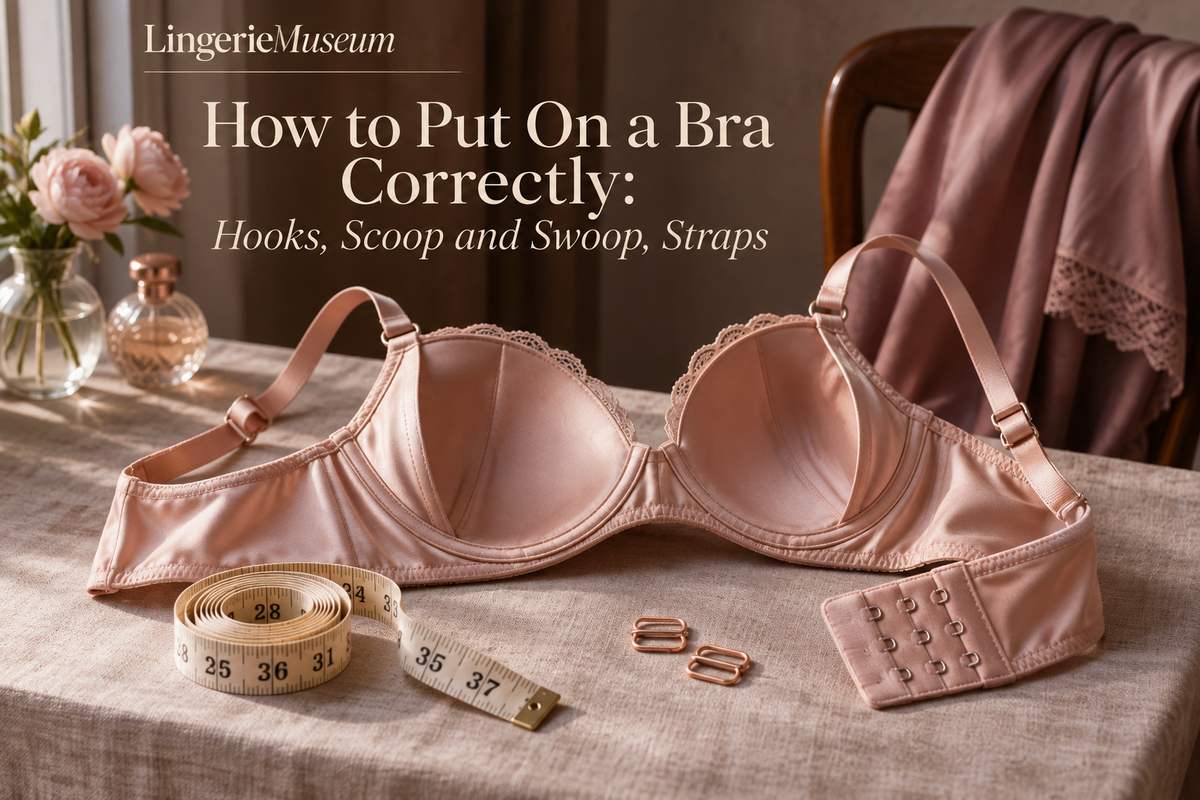
To put on a bra correctly, slip your arms through the straps, lean forward so your breasts fall into the cups, and fasten a new bra on the loosest hook. Then reach into each cup and scoop the tissue in from under your arm, stand up, check that the band sits level and the center lies flat, and adjust the straps last.
That is the whole routine, and it takes under a minute. Done carelessly, it can make a good bra look like the wrong size.
Why the loosest hook comes first
A standard back-fastening band has three columns of eyes. Simone Perele tells customers to hook the band "starting with the loosest setting" and to move to tighter hooks as the bra stretches. The British retailer TKD Lingerie says the same: a new bra "should fit on the first hook and eye." The Swedish brand Miss Mary of Sweden explains the logic: the three-stage closure means a bra "can be used for longer" because you tighten it as the elastic gives.
The outer hook is also a test. If a new bra already feels loose on the outermost column, the band is too big, and no amount of hook-shifting will fix it later. Wacoal puts the stakes plainly: "The underband supports 90% of the breast weight." Maternity and nursing bras are the usual exception, since retailers advise starting those on a tighter column to leave room for the ribcage to expand.
How to put on a bra, step by step
- Loosen the straps if they were shortened last time, and hold the bra with the cups facing out.
- Arms in, then lean forward. Simone Perele's guide calls this the start of the "swoop and scoop": "Lean forward slightly to allow your breasts into the cups naturally."
- Fasten at the back while still leaning, on the loosest column. Miss Mary notes that a hook-and-eye closure is easiest done "from the bottom up."
- Scoop each side. With your opposite hand, reach into the cup at the side, sweep the tissue from under your arm toward the center, then lift from the bottom of the cup. Repeat on the other side.
- Stand up and settle the wires. Run a finger along each wire to make sure it sits in the crease under your breast. TKD's rule is that the wires "should follow the line of your breasts and not encroach on your breast tissue."
- Adjust the straps last, with the bra already sitting where it should.
The scoop and swoop, and why fitters insist on it
The swoop is the forward lean: gravity drops the breast into the cup, the fullest part of you lands in the fullest part of the cup, and less tissue gets caught under the wire or outside the side seam. The scoop is the hand movement that collects what gravity missed, mostly soft tissue that drifts toward the armpit.
Fitters do it before judging any size, and the order matters. Tissue left outside the cup makes a cup look like it fits when it is too small. Once everything is in, many people find the top edge cuts in or the wire now sits on the breast instead of behind it, which is the cup telling you it needs to be bigger.
On wired styles it also places the wire. The underwire bra works by sitting on the ribcage around the breast, and the scoop is how you get it there.
Checking the band and the center gore
With the bra on and the tissue in place, look in a side mirror. The University of Portsmouth's Research Group in Breast Health, which studies bra fit and says the traditional tape-measure method "does not give the best fit," publishes a short list of "Best Fit" checks. Its band check: the underband should sit level all the way around the ribs and feel firm, and when you pull it away from your back it should lift only about 5 cm (2 inches).
A band that rides up at the back is too loose. It lets the front drop, and the straps then do work they were never meant to do. If it rides up on the loosest hook, try the middle one; if it still rides up on the tightest, the band size is wrong.
The gore is the small panel between the cups. Portsmouth's criterion is that the center front should lie flat against the body, and if it lifts away, a larger cup is the usual fix. Wacoal makes the same point about the wires: they should "sit flat to the breastbone on top of the ribcage, below the breast tissue." One known exception: on close-set breasts some gores cannot lie flat, and a low-center plunge bra often solves it.
Strap length, set last
Straps hold the cups in place; they are not the main support. TKD puts it at no more than 20% of the job. Simone Perele says they should give "gentle support without digging into your shoulders," and Miss Mary's test is simple: "They shouldn't cut in, but they also shouldn't slip down when you move."
If you can only stop a strap from slipping by cranking it tight, look at the band first: a loose band pulls the back down and the straps with it. And do not force both straps to the same length. Portsmouth notes that straps can be set differently on each side, which is normal, since most people's shoulders and breasts are not exact twins.
Fastening at the front and twisting round
Plenty of people hook the band at their waist, spin it round and pull it up. Miss Mary says this method works but points to the risk for wired bras: put one on upside down and you have to flip it, which "damages the underwire." If you twist a bra round, turn it by the band and not by the cups. For anyone who finds reaching behind difficult, a front-closure bra removes the twist entirely, and our complete bra type guide shows which other styles fasten where.
If every step is done and the gore still floats or the wire still sits on the breast, the routine has done its job: it has told you the size is wrong. Simone Perele recommends regular fittings for that reason, since bra size changes over time.
Last updated
Questions
Should a new bra be on the tightest or loosest hook?
The loosest. Brands such as Simone Perele and fitters such as TKD Lingerie say a new bra should fit snugly on the outermost hook, so you can move to the middle and then the tightest hook as the band elastic stretches with wear and washing. Maternity and nursing bras are the usual exception.
Do you put a bra on before or after leaning forward?
Put your arms through the straps first, then lean forward so your breasts fall into the cups, and fasten the band while you are still leaning. Gravity places the fullest part of the breast in the fullest part of the cup, and less tissue ends up trapped under the wire or outside the cup.
Is it bad to hook your bra in front and turn it around?
It works, and many people do it. The risk is to the bra rather than to you: twisting strains the band, and an underwired bra put on upside down has to be flipped, which Miss Mary of Sweden says damages the wire. Turn it by the band, not the cups, or choose a front-closure style.
How do I know if my bra straps are too tight?
Straps that leave red grooves or dig in are too tight, and straps that slip off when you move are too loose. If you can only stop them slipping by tightening hard, check the band: a band that rides up at the back is too loose, and it drags the straps down with it.
Sources
- uk.simone-perele.com: how to put a bra on correctly
- wacoallingerie.com: perfect fit
- blog.tkdlingerie.com: how to put on a bra
- missmary.com: are you putting your bra correctly
- port.ac.uk: research group in breast health
Discussion
Loading...