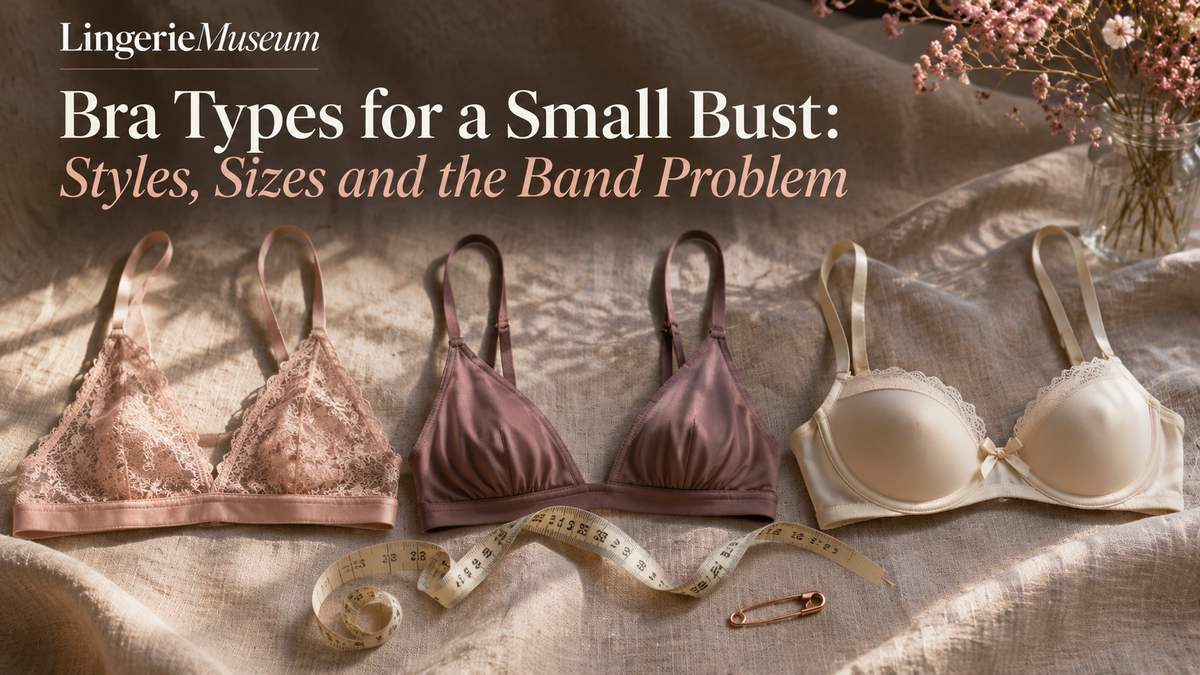
The best bra types for a small bust are the ones with little empty cup to fill: bralettes and triangle bras, plunge and demi cups with low, angled edges, and a push-up when you want more volume. Before you change style, check the band. A great many small-bust fit problems come from a band that is too big and a cup that is too small.
That second point surprises people, because a small bust seems like the easy case. It is not. Mainstream bras are rarely designed around an A cup, and the old way of measuring pushes small-chested women into the wrong size before they ever reach the fitting room.
The band problem behind small-bust fit complaints
For decades, the standard tape method in the US and UK was "plus four": measure under the bust, then add 4 inches (about 10 cm) to an even number or 5 to an odd one to get the band size. Wikipedia's bra size entry records Kohl's still using it in 2013, and a campaign against it from around 2011 known as the "war on plus four."
The research backs the critics. Jenny White and Joanna Scurr at the University of Portsmouth compared the traditional method with professional fit criteria on 45 women and published the result in Ergonomics in 2012: the traditional method "overestimated band size and underestimated cup size."
Here is what that does to a small bust. Cup letters are relative to the band. Each step down in band with a step up in cup keeps roughly the same cup volume, so a 34B, a 32C and a 30D hold about the same amount. Someone with a 28 or 30 inch (71 to 76 cm) ribcage measured by plus four lands in a 32A or 34A. The band floats, rides up the back, and the straps slip. The cups, built for a wider frame, sit too far apart and gape, so she decides she is "too small for bras."
Try this before anything else. Measure snugly under the bust with no inches added and try a band at or near that number. Then move up a cup to keep the volume: from a 34A, the sister sizes to try are 32B and 30C. Go one step at a time, since sizing varies by brand and by style.
Why standard cups gap on a small chest
Most ranges are drafted at one base size and scaled up and down. Jaclyn Fu, co-founder of the small-cup brand Pepper, put it plainly to TechCrunch in 2020: a person who is a 32A "is wearing a design that was intended for a 36C, causing fit issues like cup gaps." On a small frame that can mean a wire wider than the breast and a cup taller than the tissue it is meant to hold.
Shape matters as much as size. ThirdLove's fit guide lists three reasons for a gap at the top of the cup: a cup too large, a style that does not suit the breast shape, and stretched-out straps. Shallow breasts, or ones fuller at the bottom, leave the top of a tall cup empty in any size.
Bra types for small bust shapes, one by one
Bralettes and triangle bras
With no wire and little or no molding, there is no rigid cup to stand away from you. A soft triangle or lace bralette follows the shape you have, which suits A and B cups well. Our bralette guide covers sizing in S, M and L, and bralette vs triangle bra explains where the two part company. Triangles suit close-set breasts best; on wide-set ones the points can slide toward the center.
Plunge and demi cups
A plunge bra has angled cups and a low center gore, so there is less fabric above the breast to fill. It works best when the breasts sit close together and the gore can lie flat on the breastbone. A demi cup stops lower still. ThirdLove says balconette and demi bras "tend to have less cup to fill, making them better for slender breast shapes," though a balconette's straight upper edge needs fullness on top to lie flat.
Push-up
A push-up uses graded padding, thicker toward the bottom of the cup, to move tissue up and toward the center. ThirdLove notes that the padding helps a smaller breast fill the entire cup, which is the other way to stop a gap. The trade-off is that the bra now shapes you, not the other way round. Push-up vs plunge bra sets the two side by side.
Styles that tend to fight a small bust
Tall molded full cups are the usual problem. The foam holds its dome whether you fill it or not, so the top edge either gapes or dents. Minimizers, made to spread and flatten a larger bust, have nothing to do on a small one.
Finding AA and A cups
The letters below A exist, but they are not standard everywhere. Wikipedia notes that some UK retailers reserve AA for young teens and use AAA for adult women. Japanese and Korean labels begin at AAA, for a difference of about 5 cm (2 inches) between bust and underbust.
Mainstream department-store ranges thin out at the small end, especially in 28 and 30 bands. That gap is why specialists exist. Pepper was founded in 2017 by Jaclyn Fu and Lia Winograd, who had worked together, and it makes its own smaller cup molds at a factory in Medellin, Colombia, with shorter, less curved wires. TechCrunch gave its 2020 range as 30A to 38B.
Letter-sized bralettes are the other route. An XS or S skips the band-and-cup arithmetic entirely, at the price of precision: one Small has to cover several band and cup combinations, so it fits a 30B and a 34A equally loosely.
Last updated
Questions
What is the best bra type for a small bust?
There is no single best type, but styles with little empty cup suit small busts most easily: bralettes and triangle bras, plunge bras with a low gore, and demi cups. A push-up adds volume with graded padding. Tall molded full cups and minimizers are the styles most likely to gape. Check that the band is snug before blaming the style.
Why does my bra gap at the top if I have small breasts?
Usually the cup is too big, the style does not match your shape, or the straps have stretched, the three causes ThirdLove lists. A loose band can also let the cups sit too wide. Try a smaller cup, a plunge or demi with less fabric on top, or a band one size smaller with the next cup up.
Is AA smaller than A in bra sizes?
Yes. AA is one step below A, and AAA is smaller again. In US and UK sizing each cup letter is roughly one inch of difference between bust and underbust, so AA means very little. Japanese and Korean labels begin at AAA, about 5 cm, and some UK retailers reserve AA for teen ranges.
Should a small bust wear a padded bra?
Only if you like the look. Padding helps a smaller breast fill a cup that would otherwise gap, and graded push-up pads move tissue toward the center. But a bra that fits well does not need padding to stay flat against you. Unlined bralettes, triangles and soft plunge cups suit many small busts without any.
What is the sister size of 34A?
The sister sizes of a 34A are 32B and 36AA, which hold about the same cup volume on a different band. Go one more step and you reach 30C. If a 34A rides up at the back and gapes at the top, the 32B is the first size to try, since the band is often the real fault.
Sources
- en.wikipedia.org: Bra size
- researchportal.port.ac.uk: evaluation of professional bra fitting criteria for bra selection
- doi.org: 00140139.2011.647096
- techcrunch.com: peppers bra wants to solve the woes of small chested women
- entrepreneur.nyu.edu: nyu innovation venture fund makes 19th investment pepper
- thirdlove.com: why does my bra gap in the front
Discussion
Loading...